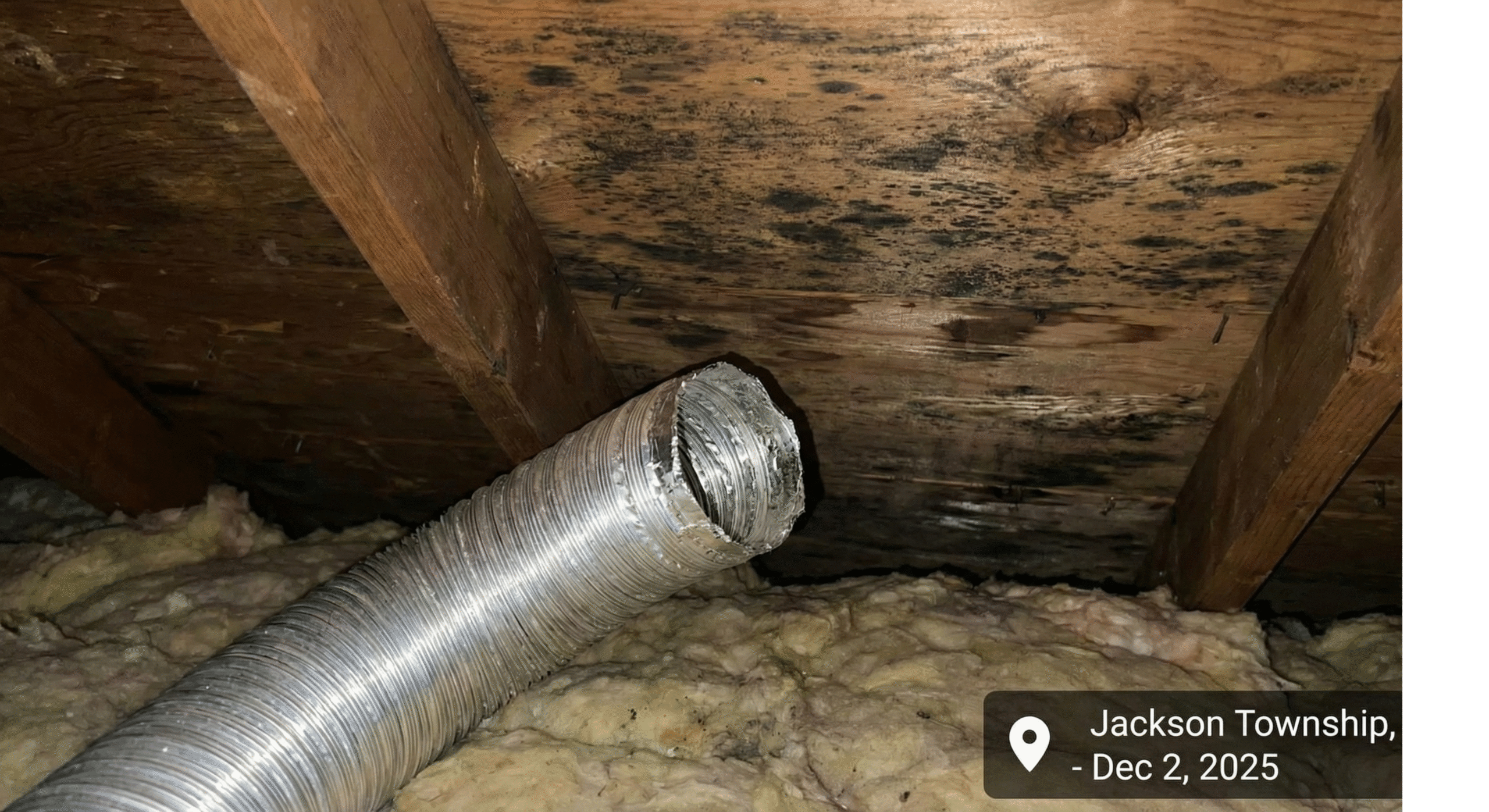
If you’ve ever climbed up into your attic and found dark patches of mold growing on the underside of your roof, your first instinct was probably to call a roofer and ask about leaks. That’s a reasonable assumption. But here’s the thing — in many New Jersey homes, especially those built between the 1970s and early 2000s, the problem isn’t your roof at all.
It’s your bathroom fan.
More specifically, it’s how that fan is (or isn’t) connected to the outside of your home. This is one of those issues that flies under the radar for years until a home inspection, a real estate transaction, or visible mold growth forces it into the spotlight. And by then, the damage can be extensive.
This article breaks down exactly how improper bathroom ventilation leads to attic mold, why it’s such a common issue in Central New Jersey homes, and what you can do about it — whether your handy or prefer to call in a professional.
Understanding the Basics: What Those Roof Vents Actually Do
Take a walk around your neighborhood in Jackson Township, Toms River, or Howell and look at the roofs. You’ll notice small, square metal vents sitting on the roof deck. Homeowners often wonder what these are — some people assume they’re related to plumbing or HVAC systems.
Some of them are. But others serve a very specific purpose: they’re exhaust terminations for your bathroom fans.
When you take a shower and turn on the bathroom exhaust fan, that fan is supposed to pull humid air out of the bathroom and push it through a duct that runs into your attic, then connects to one of those roof vents. The moisture-laden air escapes outside, and your home stays dry.
Thats the way its supposed to work, anyway.
Where Things Go Wrong
The problem shows up in a few common scenarios:
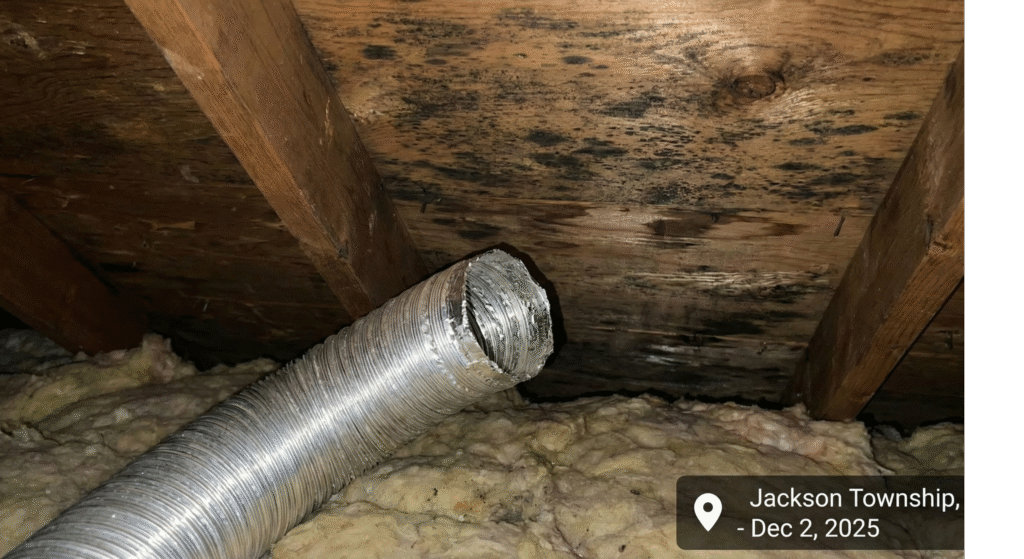
Renovations gone sideways. A homeowner or contractor replaces an old bathroom fan but doesn’t properly reconnect the exhaust duct to the roof vent. Sometimes the duct gets disconnected entirely and left sitting on the attic floor. Other times it’s connected loosely and separates over time.
DIY installations. Bathroom fan replacement seems like a straightforward weekend project. And electrically, it often is. But running the ductwork correctly — making sure it’s secured, insulated in cold climates, and properly terminated outside — is where mistakes happen.
Original construction shortcuts. In some homes, particularly those built during housing booms when contractors were rushing to complete projects, the ductwork was never properly installed in the first place. We’ve seen homes in developments throughout Ocean and Monmouth counties where the bathroom exhaust simply dumps into the attic with no connection to the exterior whatsoever.
Degraded or crushed flex duct. Even when the installation was done correctly, flexible aluminum ductwork can sag, kink, or get crushed over time. Insulation installers, cable technicians, or HVAC workers moving through the attic can inadvertently damage or disconnect these ducts without realizing it.
The Science of Attic Condensation
Here’s what happens when warm, moist air from your bathroom gets pumped directly into your attic instead of outside.
During New Jersey winters — and we get plenty of cold nights here in Burlington, Monmouth, and Ocean counties — your attic is significantly colder than your living space. When that warm, humid bathroom air hits the cold underside of your roof sheathing, condensation forms.
It’s the exact same principle as a cold glass of water “sweating” on a humid July afternoon at the Shore. Warm air holds more moisture than cold air. When warm air contacts a cold surface, that moisture has to go somewhere.
In your attic, it goes onto your plywood roof deck.
A single shower might not cause noticable problems. But this process repeating daily, week after week, month after month? That’s when mold colonies establish themselves. That’s when the plywood starts to soften and degrade. That’s when a ventilation problem becomes a structural problem.
According to the Environmental Protection Agency, mold can begin growing on damp surfaces within 24 to 48 hours under the right conditions. New Jersey’s humidity levels — particularly in coastal communities like Toms River, Brick, and Point Pleasant — create ideal conditions for mold proliferation once moisture enters an enclosed space like an attic.
Why This Issue Is So Common in Central New Jersey
Several factors make this region particularly susceptible to attic mold from ventilation problems:
Older housing stock. Many homes in established neighborhoods throughout Freehold, Howell, Jackson, and surrounding areas were built in the 1980s and 1990s when building codes around bathroom ventilation were less stringent. Exhaust fans venting directly into attics — rather than outside — was actually common practice in some areas.
Coastal humidity. Living near the Shore has its perks, but the elevated humidity levels mean any moisture intrusion problem gets amplified. A disconnected bathroom vent in Toms River is going to cause problems faster than one in a drier climate.
Seasonal temperature swings. Our winters are cold enough to create significant temperature differentials between living spaces and attics, but not so cold that attics remain frozen and dry. This creates that condensation-friendly environment where moisture accumulates rather than dissipating.
Home improvement activity. Central Jersey has seen substantial renovation activity over the past decade. Bathroom remodels are among the most popular projects, and each one represents an opportunity for ventilation mistakes if the contractor isn’t detail-oriented about ductwork.
How to Check Your Own Home
You don’t need to be a roofing professional to do a basic inspection. Here’s a practical checklist:
1. Locate your bathroom fans. Most homes have exhaust fans in each full bathroom, sometimes in half-baths as well. Turn each one on and confirm air is actually being pulled up (hold a tissue near the vent — it should get sucked toward the fan).
2. Access your attic. With a flashlight, locate where the flexible duct from each bathroom enters the attic space. In many homes, this will be directly above or near the bathroom location.
3. Trace the ductwork. Follow each duct to see where it terminates. It should connect to a rigid pipe that exits through the roof. If the duct is simply laying on the attic floor, draped over insulation, or terminates at a soffit vent (the vents under your roof overhang), you’ve found your problem.
4. Check for existing damage. While your up there, look at the underside of your roof sheathing. Dark staining, visible mold growth, or soft/spongy plywood are all signs that moisture damage has already occured.
5. Inspect duct connections. Even if the duct appears to run to the right place, check that connections are secure. Flexible duct should be fastened with proper clamps, not just friction-fit or held with duct tape (which degrades quickly in attic temperature extremes).
What Proper Bathroom Ventilation Looks Like
A correctly installed bathroom exhaust system includes:
- An appropriately sized fan for the bathroom square footage (measured in CFM — cubic feet per minute)
- Insulated flexible or rigid ductwork running from the fan housing through the attic
- A secure connection to a roof-mounted vent cap designed for exhaust termination
- Proper sealing at all connection points to prevent air leakage
- A duct route that minimizes length and turns, which reduces efficiency
The vent cap on the roof should have a damper or flapper that opens when the fan runs and closes when it stops, preventing outside air, rain, and pests from entering the duct system.
The Cost of Ignoring the Problem
Homeowners sometimes postpone addressing ventilation issues because the mold isn’t visible from living spaces. Out of sight, out of mind. But the costs of delay can be substantial:
Roof deck replacement. Once plywood sheathing is compromised by rot, it needs to be replaced. This isn’t a simple repair — it requires removing roofing materials, cutting out damaged decking, installing new plywood, and re-roofing the affected area.
Mold remediation. Depending on the extent of growth, professional mold remediation can run several thousand dollars. If mold has spread to insulation, that material will need removal and replacement as well.
Health concerns. While not all mold is dangerous, prolonged exposure to mold spores can aggravate allergies, asthma, and other respiratory conditions. Homes with immunocompromised residents should take attic mold particularly seriously.
Real estate complications. Home inspections routinely flag attic mold. If your planning to sell in communities like Marlboro, Manalapan, or anywhere in the region, unaddressed attic mold can delay closings, reduce offers, or require negotiated repairs.
Fixing the Problem
The repair itself is usually straightforward for a professional. It involves:
- Properly routing and securing ductwork from the bathroom fan to the roof
- Installing or replacing the roof vent cap with an appropriate exhaust termination
- Sealing all connections
- Addressing any existing mold or moisture damage
For homeowners who’ve already experienced mold growth, remediation should happen before or alongside the ventilation repair. There’s no point fixing the moisture source if you leave active mold colonies in place.
Some homeowners attempt DIY duct repairs, which can work if you’re comfortable working in attic spaces and understand proper installation techniques. However, the roof penetration for the vent cap typically requires roofing experience to ensure it’s watertight and won’t create a new leak problem.
Prevention for New Construction and Renovations
If your building a new home or planning a bathroom renovation, insist on proper ventilation from the start:
- Specify that all bathroom exhaust ducts terminate through the roof with dedicated vent caps
- Request insulated ductwork to prevent condensation inside the duct itself
- Avoid soffit terminations, which can pull exhausted air back into the attic through soffit vents
- Consider rigid ductwork for longer runs, as it maintains airflow better than flexible options
These details might seem minor compared to tile selections and fixture finishes, but they’ll save you significant headaches down the road.
When to Call a Professional
If your attic inspection reveals disconnected ducts, visible mold, or damaged sheathing, it’s worth getting a professional assessment. A qualified roofing contractor can evaluate the extent of any damage, properly install ventilation components, and address mold issues before they spread.
For homeowners in Jackson Township, Toms River, Freehold, Howell, Brick, and throughout Monmouth, Ocean, and Burlington counties, Elegant Exteriors provides comprehensive roof and attic inspections. As a GAF Master Elite Contractor, we see these ventilation issues regularly and can identify problems that homeowners often miss.
Take Action Before Small Problems Become Big Ones
Attic mold from bathroom ventilation failures is one of those home maintenance issues thats completely preventable — but only if you know to look for it. A 15-minute attic inspection could save you thousands in repairs and protect your family’s health.
If you haven’t checked your bathroom exhaust routing recently, add it to your weekend to-do list. And if you find something concerning, don’t wait for it to get worse.
Have questions about your roof, attic ventilation, or suspect moisture problems in your home? Contact Elegant Exteriors for a free inspection. We serve homeowners throughout Central New Jersey and are happy to take a look.