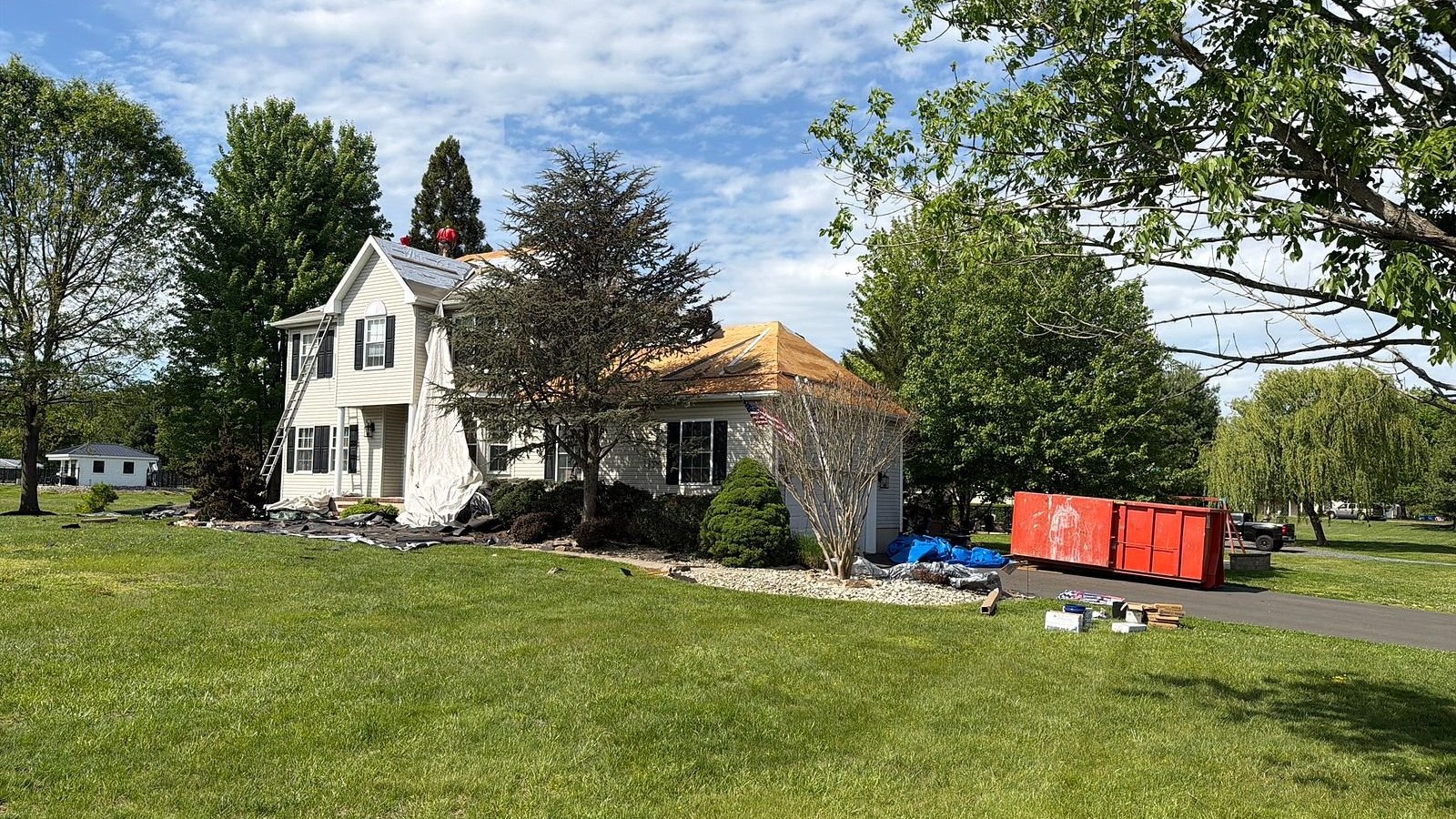
Most roofs don’t fail on a specific day. They wear out over a few years, and somewhere in that stretch there’s a point where fixing it stops making sense and replacing it starts to. The problem is that nobody tells you when you’ve crossed that line. You find out when a ceiling stains, or when a roofer gives you a number you weren’t ready for.
This guide is for figuring out where your roof is on that timeline before it decides for you. It covers how long roofs actually last in New Jersey (shorter than the box says), what to look for from the ground and from the attic, when a repair still makes sense, and the point at which it doesn’t.
When should you replace your roof?
In New Jersey, most asphalt shingle roofs should be replaced between 18 and 25 years old, earlier than the 25 to 30 year rating on the shingle, because coastal humidity, nor’easters, and freeze-thaw winters wear them faster. Replace sooner if shingles are brittle or curling across multiple slopes, granules are collecting in the gutters, the attic shows daylight or water staining, or you’ve had more than two repairs in five years. A single damaged area on a roof under 15 years old is usually a repair, not a replacement.
How Long a Roof Actually Lasts in New Jersey
The number printed on the shingle bundle is a warranty term, not a life expectancy. A “30-year” architectural shingle is rated to resist manufacturing defects for 30 years under reasonable conditions. New Jersey is not reasonable conditions.
Between the salt air that reaches well inland from the coast, humidity that keeps roofs damp for days, nor’easters that drive rain sideways, and winters where temperatures cross freezing dozens of times, roofs here age faster than the same product would in a milder climate. The practical lifespans we see:
| Roof Type | Rated Lifespan | Realistic NJ Lifespan | Start Watching At |
|---|---|---|---|
| 3-tab asphalt | 20 to 25 years | 15 to 20 years | Year 12 |
| Architectural asphalt | 25 to 30 years | 18 to 25 years | Year 15 |
| Architectural, coastal exposure | 25 to 30 years | 15 to 20 years | Year 12 |
| Premium / designer asphalt | 30 to 50 years | 25 to 35 years | Year 20 |
| Standing seam metal | 40 to 70 years | 40+ years | Year 30 |
Two things shorten those numbers further. Builder-grade installations from the 1990s and 2000s development boom often used felt underlayment and minimal ventilation, which cook shingles from underneath. And a roof-over (new shingles installed on top of old ones) runs hotter and tends to die 5 to 8 years earlier than a tear-off.
Find Out How Old It Is
You can’t place your roof on the timeline without knowing when it went on. If you don’t know:
Check your closing documents. The seller’s disclosure or home inspection report from when you bought the house usually estimates roof age.
Pull the permit history. Every NJ municipality keeps construction permit records. A roof replacement should have one. Call the building department or check online if your town has a portal.
Ask the neighbors. In developments, houses went up together and often got roofs together. If three neighbors on your street replaced in the last two years, your roof is their age.
Look at the shingle style. Flat, uniform 3-tab shingles on a house built before 2000 are almost certainly original. Dimensional architectural shingles are more recent.
The Signs, Sorted by What They Actually Mean
Not every warning sign points to replacement. Some mean “fix this spot.” Some mean “the roof is done.” Here’s how to tell them apart.
Signs that usually mean a repair
A few missing shingles after a storm on a roof that’s otherwise flat and intact. Wind found a weak seal. Replace the shingles, reseal the neighbors.
A leak at a chimney, skylight, or pipe boot. These are flashing failures, not shingle failures. The fix is new flashing or a new boot, and it has nothing to do with the roof’s age.
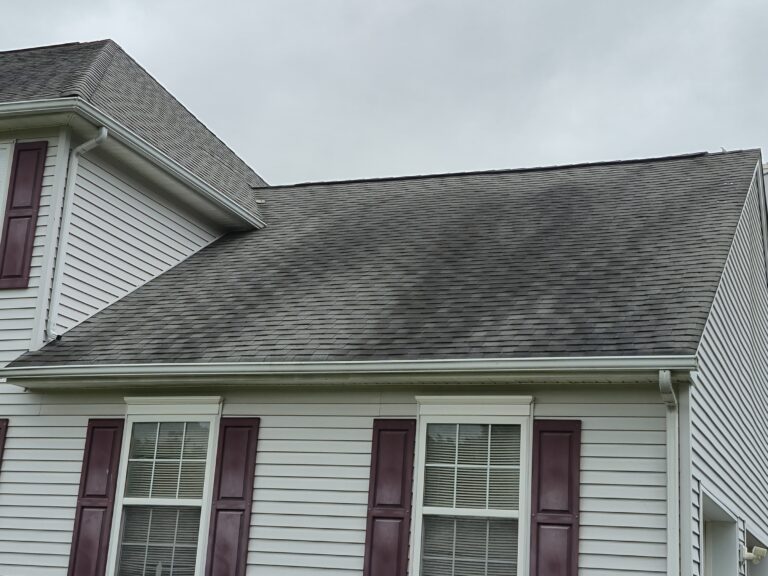
Moss or algae in one shaded area. Cosmetic if caught early. Clean it, trim the branch causing the shade, and keep an eye on it.
Lifted shingles along one edge. Usually a seal that broke in wind. Can be hand-sealed if the shingle is still flexible.
Signs that usually mean replacement
Curling or cupping across more than one slope. When shingle edges turn up on the front and the back of the house, the asphalt has dried out everywhere, not just where you noticed it first.
Granules in the gutters, consistently. A little after a storm is normal. A layer of sand-like grit every time you clean the gutters means the shingles are shedding their UV protection and the asphalt underneath is exposed.
Bald patches. Dark spots on the roof where the granules are gone entirely. Once the asphalt is exposed it breaks down quickly.
Shingles that crack when lifted. This is the single clearest sign. If you (carefully, from a ladder) lift the corner of a shingle and it resists or cracks instead of flexing, the roof can’t be repaired. Every shingle a repair crew touches will crack too.
Daylight in the attic. Turn off the lights on a sunny day and look up. Pinpoints of light at nail heads or along the ridge mean fasteners have backed out or the ridge cap is failing.
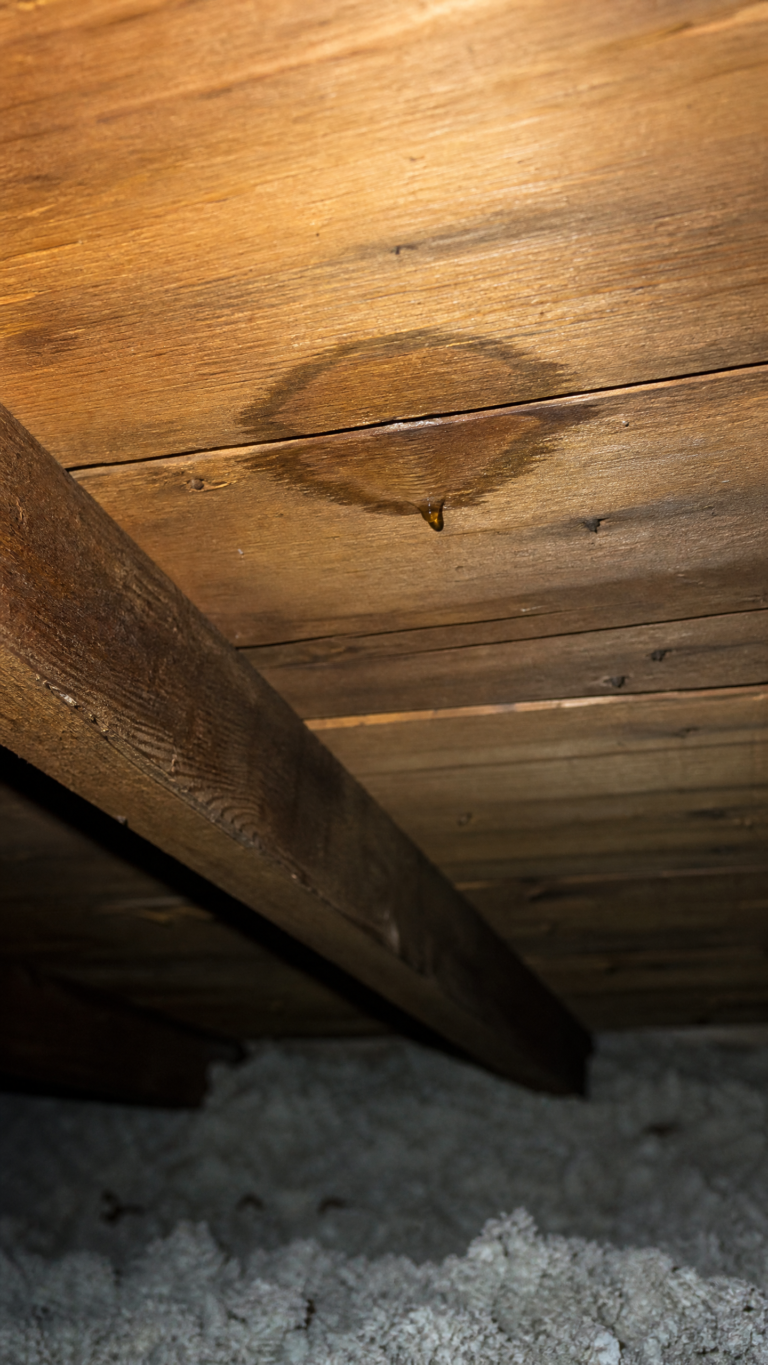
Water staining on the underside of the decking in more than one area, or staining that’s dark and soft rather than dry and old.
A sagging ridge or a dip in a slope. This is structural. The decking or the framing beneath it has been wet long enough to lose strength. Replacement, and soon.
| What You See | Repair | Replace | Why |
|---|---|---|---|
| A few missing shingles, one area | ✓ | Storm event, not age | |
| Leak at chimney or skylight | ✓ | Flashing problem, any roof age | |
| Moss or streaking, one shaded slope | ✓ | Clean and address the shade | |
| Curling on multiple slopes | ✓ | Asphalt has dried out roof-wide | |
| Granules in gutters every cleaning | ✓ | UV protection is gone | |
| Shingles crack when lifted | ✓ | Can’t be repaired without causing more damage | |
| Daylight or staining in attic, multiple spots | ✓ | System failure, not a single leak | |
| Sagging ridge or slope | ✓ | Structural. Don’t wait. |
The Repair Math
Repairs make sense when the roof has life left. They stop making sense when you’re paying to extend something that’s already at the end.
The rule we use: if a repair estimate is more than roughly 30% of what a replacement would cost, and the roof is past 15 years, replace it. You’ll pay for the repair, and then you’ll pay for the replacement anyway, probably within two or three years. That’s the same money spent twice.
The other test is frequency. One repair in a decade is normal. Two in five years is a pattern. Three means the roof is telling you something and the next call shouldn’t be for a repair.
If you’re in Jackson Township, we also put together a town-specific checklist: Signs You Need a New Roof in Jackson, NJ.
Why Waiting for the Leak Costs More
A lot of homeowners treat the first ceiling stain as the signal to start thinking about replacement. By then the window for doing it cheaply has usually closed.
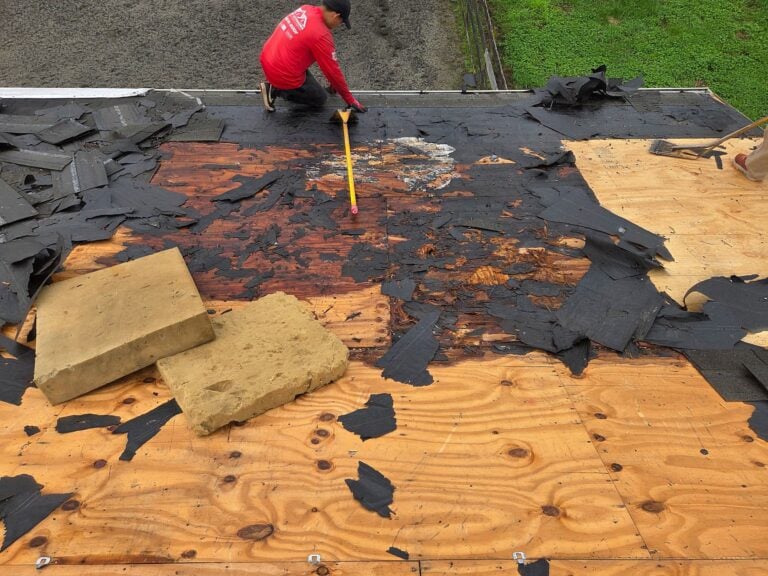
Water doesn’t come through a ceiling the day it gets past the shingles. It runs along rafters, soaks into insulation, and sits on the plywood deck for weeks or months first. By the time there’s a stain, there’s often rotted decking that has to be replaced along with the roof. On a 20-year-old roof, that turns a straightforward replacement into one with decking repairs, sometimes insulation, sometimes drywall. The same job, 20 to 40% more expensive than it would have been the previous spring.
If the signs above put your roof in the “replace within a few years” bracket, the cheapest version of that job is the one you schedule on your own terms.
A Quick Note on Replacing Shingles vs. the Whole Roof
People often ask whether they can replace just the shingles and leave everything else. On a full replacement, the shingles are what come off, but what goes back on is a system: ice and water shield, underlayment, drip edge, flashing, ventilation, then shingles. Replacing only the shingles over old underlayment and old flashing is possible but rarely done well, and it voids most enhanced warranties. If the shingles are at end of life, the layers under them usually are too.
Partial replacement of one slope is a real option on younger roofs with isolated damage. On a roof past 15 years, matching new shingles to old ones is hard, and the untouched slopes will need replacing within a few years anyway.
What to Do If You’re Not Sure
Get it inspected. Not a satellite quote, an actual person on the roof and in the attic. A proper inspection takes under an hour, is usually free, and will tell you one of three things: it’s fine, it needs a specific repair, or it’s time. All three are useful answers, and two of them cost you nothing.
The best time to do that is before you need to, which means this fall or early spring, not the week after a nor’easter when every roofer in the county is booked.
TL;DR: New Jersey roofs last 18 to 25 years for architectural shingles and 15 to 20 near the coast, shorter than the rating. Find your roof’s age from closing documents or permit records. Repair when damage is in one spot, the shingles still flex, and the roof is under 15. Replace when curling or granule loss shows on multiple slopes, shingles crack when lifted, the attic shows daylight or staining, or a repair quote tops 30% of a new roof. Don’t wait for a ceiling stain; by then decking repairs are usually part of the job.
Want a straight answer on where your roof stands?
Schedule a free inspection and we’ll go on the roof and in the attic, then tell you whether it’s fine, needs a repair, or needs replacing. Serving Monmouth, Ocean, and Burlington counties.